Why is it that the person who's bad for you feels like fireworks, while the kind, steady, reliable person feels like nothing at all?
If you've ever stayed too long with someone who hurt you, or walked away from someone good because you "just didn't feel the spark," you're not broken, and you're not alone. This is one of the most common patterns I see in my work helping people choose the right partner and decide whether to stay.
The answer isn't that you're attracted to pain. It's that your brain and body are wired in ways that can make unhealthy relationships feel more powerful than healthy ones. Once you understand why, you can stop mistaking intensity for love.
1. Unpredictable love is addictive
Dopamine is the brain's "want more" chemical. Most people think it's released when we get a reward, but it's actually most powerful when a reward is uncertain.
When your brain can't predict what's coming next, it stays on high alert, constantly scanning for the next text, the next "I love you," the next sign that things are okay. And when that reward finally comes, the relief and pleasure feel enormous.
Psychologists call this intermittent reinforcement, and it's the same principle that makes slot machines so hard to walk away from. You don't keep pulling the lever because you win every time. You keep pulling because you might win.
A partner who is loving one day and cold the next works on your brain the same way. The hot-and-cold cycle keeps you hooked, not because the relationship is good, but because it's unpredictable.
2. Your body mistakes anxiety for attraction
In a famous psychology experiment, people who met an attractive stranger on a high, shaky suspension bridge were more likely to feel drawn to that person than people who met them on a low, solid bridge. Why? Their hearts were already racing from fear, and their brains interpreted that racing heart as attraction.
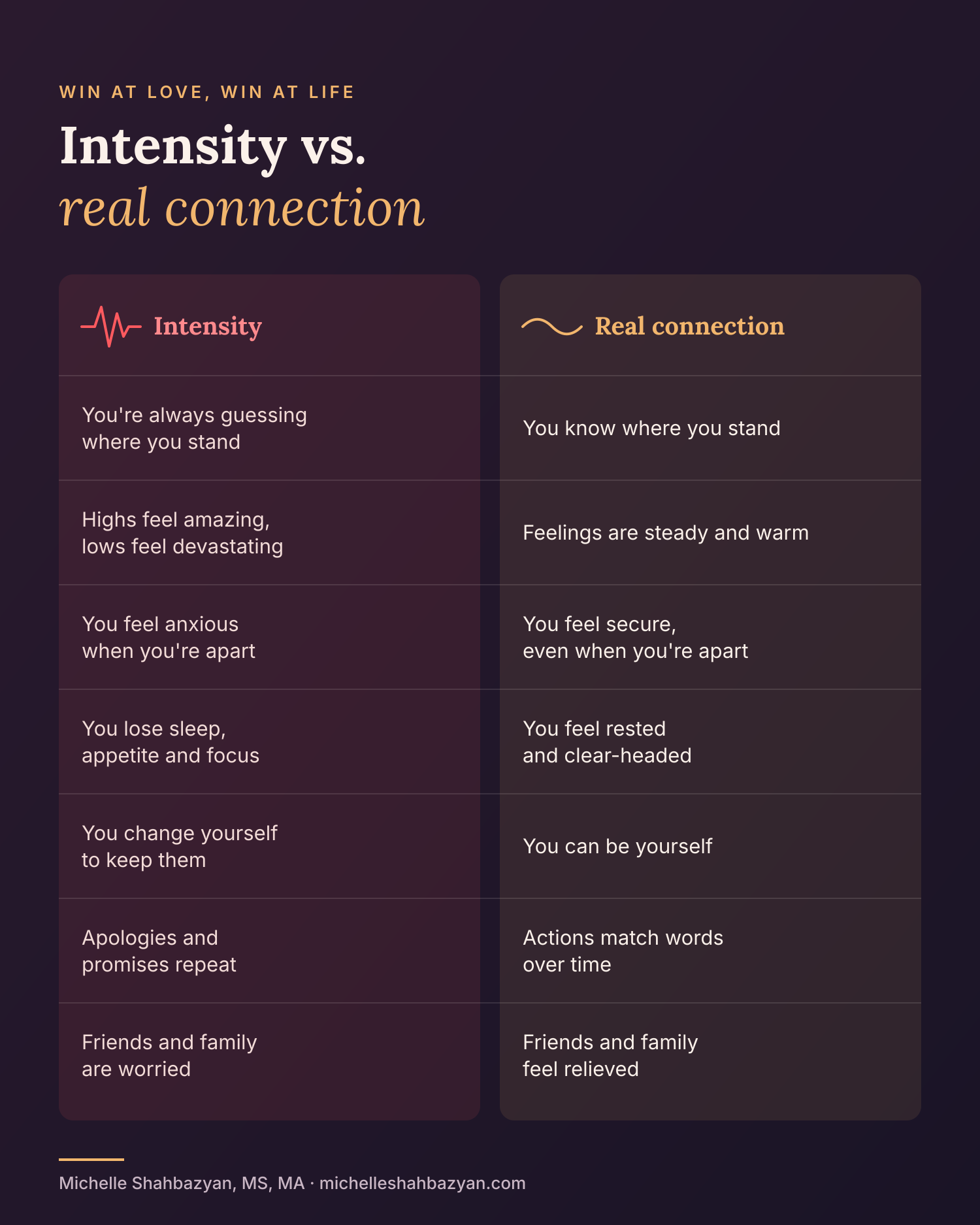
The same thing happens in relationships. Anxiety and attraction feel remarkably similar in the body: a pounding heart, butterflies in your stomach, trouble eating or sleeping, and thoughts you can't turn off.
So when someone keeps you guessing, your stress response is constantly activated, and your brain reads that stress as chemistry. You think, "I've never felt this way about anyone," when what you're really feeling is your nervous system sounding an alarm.
3. The wrong person often feels familiar
We're drawn to what feels familiar, even when familiar means painful.
If you grew up with a parent who was loving one moment and distant, critical or frightening the next, your brain learned an early lesson: this is what love feels like. As an adult, a partner who treats you the same way doesn't feel wrong. It feels like home.
This is a core idea in attachment science. Our earliest relationships create a blueprint for what we expect from love, and without realizing it, we're drawn to people who fit that blueprint. Sometimes we're even unconsciously hoping that this time, we can finally win the love we never got as children.
That's why so many people say, "I keep dating the same person in a different body." It's not bad luck. It's a pattern, and patterns can be changed.
4. Pain followed by relief creates a trauma bond
When a relationship cycles between hurt and affection, something powerful happens in the brain. During conflict or coldness, stress hormones surge. Then, when your partner apologizes, comforts you or turns loving again, your brain floods with relief and bonding chemicals.
Over time, your brain starts to link the person who hurts you with the person who comforts you. They become both the source of your pain and your only relief from it. This is called a trauma bond, and it can make an unhealthy relationship feel stronger and more meaningful than a healthy one.
It's also why leaving can feel physically painful, almost like withdrawal. People in trauma bonds often say, "I know it's bad for me, but I can't let go." That isn't weakness. It's chemistry, and with the right support, it can be broken.
5. The chase makes them seem more valuable
We tend to want what we can't easily have. When someone is emotionally unavailable, slow to commit or always half out the door, the uncertainty makes them seem more valuable, and winning their love starts to feel like the ultimate prize.
This can be especially strong for people who struggle with self-worth. Getting an unavailable person to finally choose you can feel like proof that you're lovable. But the chase is exhausting, and even when you "win," the relief rarely lasts, because the person who made you chase usually keeps you chasing.
Why the right person can feel "boring"
Now imagine meeting someone who texts when they say they will, shows up on time, is kind to you and clear about what they want. There's no guessing, no drama, no waiting by the phone.
For someone whose brain is used to chaos, this can feel strangely flat. Without the uncertainty, there's no dopamine spike. Without the anxiety, there's no racing heart. So your brain concludes, "There's no chemistry."
But what you're feeling isn't the absence of love. It's the absence of fear. A healthy partner lets your nervous system relax, and if you've never experienced that kind of calm in a relationship, it can feel unfamiliar, even uncomfortable, at first.
Many of the happiest couples I've worked with say their attraction grew over time. The spark didn't come from drama. It came from feeling truly safe, seen and cared for.
What the wrong relationship does to your body
That intensity comes at a cost. When you're constantly on edge in a relationship, your body stays in a state of chronic stress. Over time, that can affect:
Sleep: Racing thoughts, trouble falling asleep and waking up anxious
Mood: Higher risk of anxiety and depression
Focus: Trouble concentrating at work or being present with your children
Physical health: Headaches, stomach problems, tension and a weaker immune system
Self-worth: A slow loss of confidence and a sense that you're "too much" or "not enough"
A healthy relationship, on the other hand, acts like a buffer against stress. Research consistently links supportive, stable relationships with better mental and physical health. The right person doesn't just feel better. They're better for you.
How culture teaches us to crave the wrong kind of love
It's not just your brain. Our culture has spent generations teaching us that real love is supposed to hurt. Think of the stories we grow up with: the jealous lover who "can't live without you," the couple who fight passionately and then make up, the bad boy or bad girl who's secretly tender with the right person.
Love songs celebrate heartbreak and obsession. Movies end at the dramatic kiss, never showing the steady years that make love last. Social media rewards relationship drama with likes and views.
And in some families and communities, chaos is simply normal. Yelling means you care. Jealousy means you matter. Calm means someone has stopped trying. If that's the world you grew up in, a peaceful relationship can feel foreign, even suspicious.
When everything around you says intensity equals love, it takes real awareness to choose differently.
How to retrain your attraction
The good news is that your brain can learn new patterns. What feels attractive to you today isn't fixed. Here's where to start:
Name the pattern. Look back at your past relationships. What did the people who hurt you have in common? How did each relationship feel at the beginning?
Question the spark. When you feel instant, overwhelming chemistry, slow down and ask, "Is this attraction, or is this familiar?"
Give steady people a real chance. Don't rule someone out after one or two calm dates. Attraction to a healthy partner often grows as trust grows.
Notice how your body feels. After time with someone, do you feel calm and energized, or anxious and drained? Your body often knows before your mind does.
Judge by actions over time. Consistency, kindness and follow-through matter far more than grand gestures and intense moments.
Fill your own cup. When your life is full of friends, purpose and self-respect, you're far less likely to chase someone who makes you feel unworthy.
Get support. Patterns that started in childhood are hard to see on your own. A coach or therapist can help you understand where yours began and how to change it.
You deserve love that feels safe
If the wrong person has always felt more exciting than the right one, there's nothing wrong with you. Your brain learned to associate love with uncertainty, and our culture taught you that pain is proof of passion.
But love isn't supposed to feel like a roller coaster you can't get off. Real love feels like coming home to a place where you can finally exhale.
If you're trying to break this pattern, decide whether the person you're with is right for you, or find the strength to walk away, I'd love to help. You'll be okay, and you deserve a love that lets you rest.
Want to go deeper? In my book, Win at Love, Win at Life, I share practical guidance to help you break unhealthy patterns, recognize a healthy partner and build a love that feels safe and lasts. Get your copy on Amazon.