You can't eat. You can't sleep. You check your phone every few minutes, and when their name pops up, your heart races. You can't stop thinking about them. Everyone around you says, "You're in love!"
Here's the truth most people never hear: what we call "being in love" is very often infatuation.
Movies, songs and romance novels have taught us that love is supposed to feel like fireworks, butterflies and obsession. So when we feel that rush, we call it love, and we make huge decisions based on it. We move in together, get engaged, leave stable partners or stay with people who hurt us, all because it feels like love.
But inside your brain, that feeling has much more in common with craving than with lasting love. Real love is something different: steadier, calmer and built over time. After many years of helping people choose the right partner and decide whether to stay with the one they have, I can tell you that confusing the two is one of the most common and costly mistakes people make.
Here's what neuroscience tells us about the feeling we call love, and what real love actually looks like.
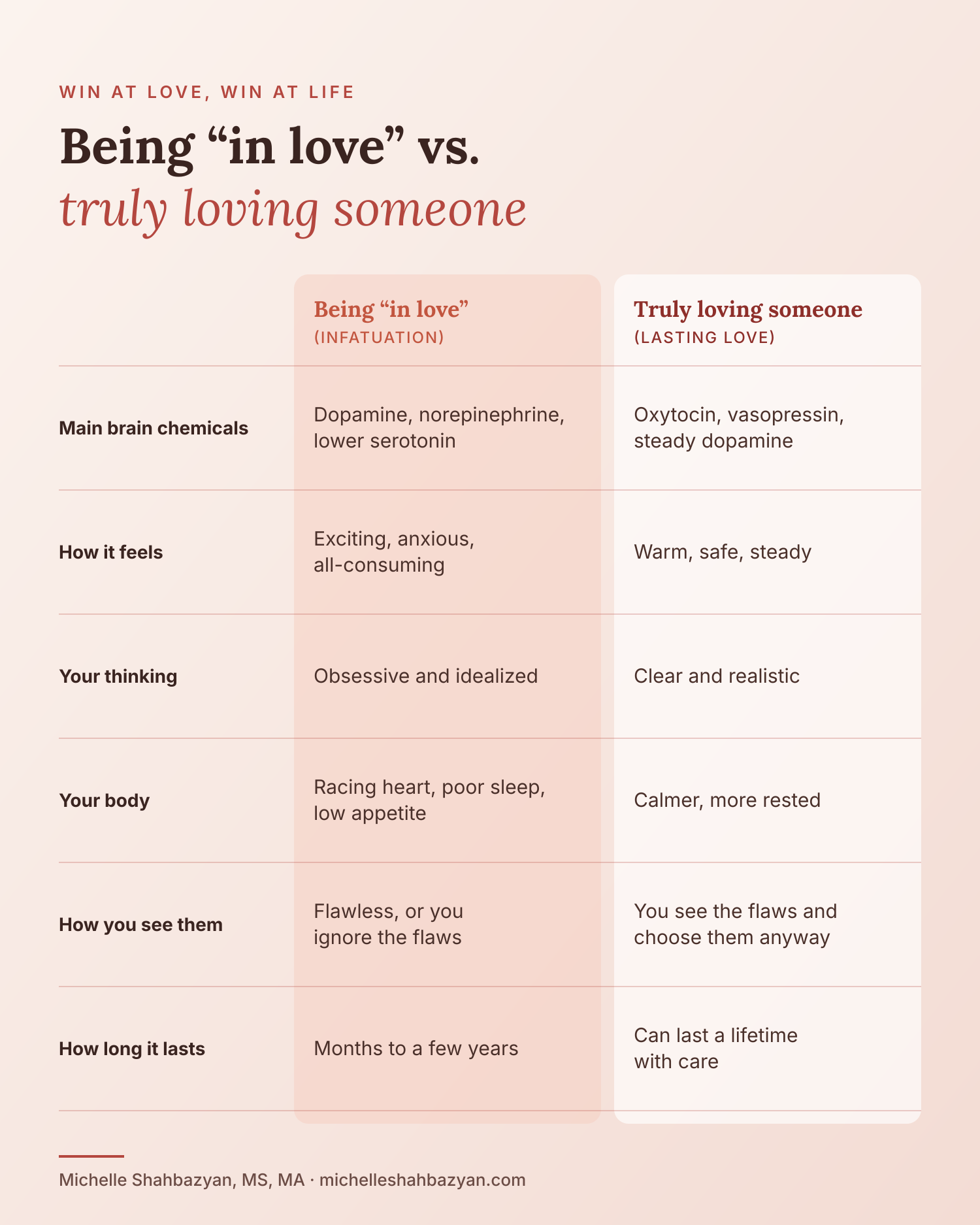
The feeling we call "being in love" is infatuation
When researchers scan the brains of people who say they've just fallen madly in love, the areas that light up most are part of the brain's reward system, the same system involved in craving and addiction. That head-over-heels feeling isn't proof of deep love. It's a powerful chemical state.

Dopamine drives the craving. Dopamine is the brain's "want more" chemical. In early romance, it floods the reward centers deep in your brain every time you see, text or even think about the person. That's why you feel energized, focused on them and desperate for the next interaction.
Norepinephrine revs up your body. This stress-related chemical is behind the racing heart, sweaty palms, loss of appetite and sleepless nights. Your body is on high alert, which feels thrilling, but it's actually a form of stress.
Serotonin drops, and the obsessing begins. Studies have found that people in early, intense love can have lower serotonin activity, in a pattern similar to what's seen in obsessive-compulsive disorder. That helps explain why you can't stop replaying conversations or imagining your future together.
Your judgment quiets down. At the same time, parts of the brain involved in critical judgment and fear tend to become less active. In other words, "love is blind" is partly biology. Your brain literally makes it harder to notice flaws and red flags.
Put it all together, and "being in love" is a perfect storm: intense craving, a stressed and energized body, obsessive thinking and lowered judgment. It's exciting, and it's real, but it's not the same as loving someone. And it's not a reliable foundation for a life-changing decision.
Why infatuation fades
Your brain can't stay in that heightened state forever, and it isn't meant to. Researchers who study intense romantic obsession generally estimate that it lasts anywhere from several months to a few years, and studies have found that the chemical changes of early love tend to settle back toward normal within a year or two.
This is the moment many people panic. The butterflies are gone, so they say, "I love you, but I'm not in love with you anymore." Some leave. Others start looking for that rush with someone new, and the cycle starts all over again.
But losing that "in love" feeling isn't the end of love. Very often, it's the moment real love finally has a chance to begin.
Real love: what comes after "in love"
As infatuation settles, a different set of brain chemicals takes the lead, ones built for bonding and security rather than excitement.
Oxytocin builds trust and closeness. Often called the bonding hormone, oxytocin is released through touch, affection, sex and shared experiences. It helps you feel safe, connected and calm with your partner.
Vasopressin supports commitment. Research in animals that form lifelong pairs shows that vasopressin plays a key role in partner preference and protective, loyal behavior. In humans, it's linked to long-term attachment.
The brain's calming systems engage. A secure, loving partner helps regulate your stress response. Being near them can lower your heart rate and help your body recover from stress more quickly.
Here's the most hopeful finding: when researchers scanned the brains of couples who reported still being intensely in love after many years together, they saw activity in the same reward areas as new lovers, plus areas linked to attachment and calm. What they didn't see was the obsession and anxiety of early infatuation.
In other words, lasting love can keep the spark. It just doesn’t have the panic.
Why the wrong person can feel more intense
This is where many people get stuck. Why does the person who's bad for you feel like fireworks, while the kind, stable person feels like nothing?
The answer is in how dopamine works. Your brain releases the most dopamine when rewards are unpredictable. A partner who is loving one day and distant the next keeps your reward system constantly guessing, and that uncertainty makes the craving stronger. It's the same principle that makes slot machines so hard to walk away from.
If you grew up with love that was inconsistent or unsafe, your brain may have learned to read anxiety as attraction. The racing heart and the knot in your stomach feel like chemistry, when they're really your nervous system sounding an alarm.
Meanwhile, a steady partner doesn't trigger that rush, so your brain may label them "boring," even though they're exactly the kind of person who can give you lasting love.
Intensity isn't the same as compatibility. Sometimes the strongest feelings come from the least healthy connections.
How to tell which one you're feeling
When your brain is flooded with chemicals, you need clear questions to cut through the noise. Ask yourself:
Do I feel calm or anxious around them? Love feels safe. Infatuation often feels like walking on a tightrope.
Do I know who they really are? Can you name their flaws, values and goals, or are you filling in the blanks with fantasy?
How long has it been? If it's only been a few weeks or months, give your brain time to settle before making big decisions.
Do they show up consistently? Love is proven through steady actions over time, not intense moments.
What do the people who care about me think? Friends and family can often see what your brain is hiding from you.
Would I still choose them without the rush? Imagine an ordinary Tuesday together five years from now. Does that picture still feel good?
If you're honest with yourself, these answers will tell you far more than the butterflies ever could.
Enjoy the feeling, but don't mistake it for love
Being "in love" isn't bad. It's how nature gets two people interested enough to find out whether they can build something real. The mistake is believing that feeling is love, and treating it as proof that you've found the right person.
Real love is quieter, steadier and much more powerful over time. It's the person who makes your nervous system relax, not race. It's the one you can see clearly, flaws and all, and still choose.
In my work, I look at love through five lenses: biology, neuroscience, anthropology, logic and real life. When you understand all five, you stop being controlled by chemistry and start making choices that lead to a relationship you'll be proud of.
If you're trying to decide whether what you're feeling is love or infatuation, or whether the person you're with is right for you, I'd love to help. You don't have to figure it out alone.